The Ultimate Guide to 2D Action RPG Development with Godot
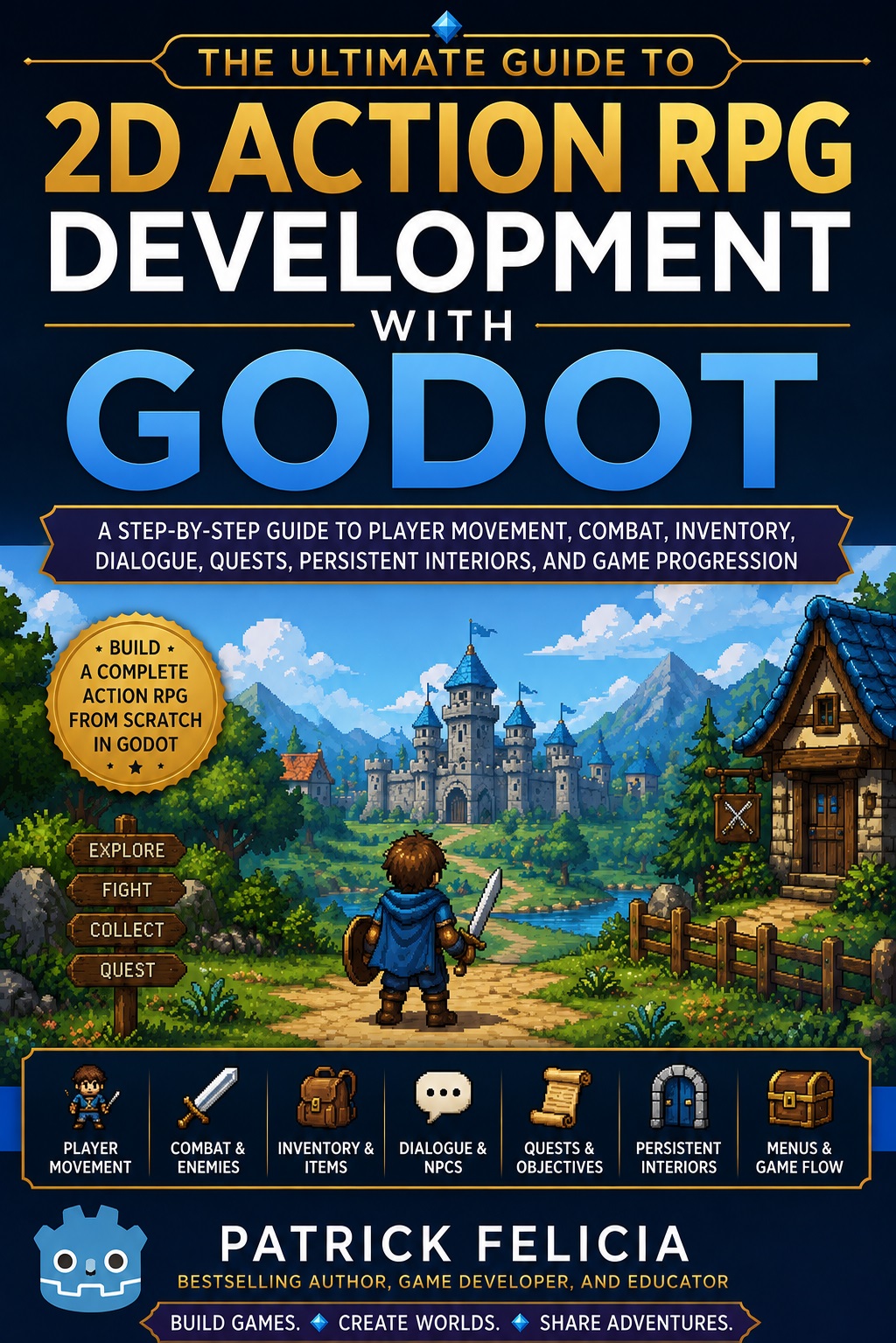 |
A Step-by-Step Guide to Combat, Inventory, Dialogue, Quests, and Game Progression for 2D RPGs by Patrick Felicia |
Book Description
Build a Complete 2D Action RPG with GodotLearn how to build a complete 2D action RPG with Godot through one practical, step-by-step project.
Starting with an empty project, you will progressively create a playable world, animated character, collectibles, combat, intelligent enemies, persistent interiors, branching dialogue, data-driven quests, menus, and complete game progression.
What You Will Learn
By completing this book, you will learn how to:
- Create a 2D RPG world using TileMapLayer.
- Implement four-direction movement, collisions, animations, and camera control.
- Build collectibles, health, keys, weapons, HUD elements, and persistent world objects.
- Create player combat, enemy health, damage, and loot systems.
- Develop enemies with state-based behaviours, patrols, and navigation.
- Create doors, houses, scene transitions, generated items, and persistent interiors.
- Build branching NPC conversations using JSON-driven dialogue.
- Create JSON-driven quests with collection, talk, reach, and defeat objectives.
- Track objectives, sequential quests, and persistent quest progress.
- Create menus, completion screens, replay options, and complete game flow.
What You Will Build
- Chapter 1 – World and Player: Create the project, build the world, and add four-direction movement, collisions, animations, and a camera.
- Chapter 2 – Collectibles, Inventory, and HUD: Add gold, health, potions, keys, a sword, interface elements, messages, and persistent collectibles.
- Chapter 3 – Combat and Enemies: Create attacks and intelligent enemies with health, state-based behaviours, patrols, navigation, animations, and loot.
- Chapter 4 – Doors and Persistent Interiors: Build locked doors, reusable houses, scene transitions, generated interior items, and persistent contents.
- Chapter 5 – NPC Dialogue: Create NPC interactions and JSON-driven conversations with branching player choices and gameplay events.
- Chapter 6 – Data-Driven Quests: Build sequential JSON quests with multiple objective types, progress tracking, completion, and saved quest state.
- Chapter 7 – Final Integration: Add menus, completion screens, replay options, state management, scene-transition testing, and final game integration.
Learn by Building
Each chapter builds on the previous one and concludes with a summary, quiz, and practical challenge. By the end of the book, you will have created a complete 2D action RPG framework and learned how its major gameplay systems work together.
Start building your complete 2D action RPG with Godot today.